Why Backtesting with 1-Minute Data is Dangerous
Your backtest shows a 180% CAGR. Sharpe 3.4. Near-zero drawdown. You deploy ₹5L. In three weeks, the strategy is down 28%.
This is not bad luck. This is what 1-minute data does to intelligent people who trust it too much. Let's break down exactly why — and what actually works.
The Core Problem: You're Fitting to Noise
A 1-minute OHLC bar doesn't represent the market. It represents one snapshot of a noisy, microstructure-contaminated stream of prices. Every 1-minute close is polluted by bid-ask bounce — prices oscillating between ₹100.05 and ₹99.95 not because of any real movement, but because of the mechanical alternation between buyers hitting the ask and sellers hitting the bid.
⚠ The Bid-Ask Bounce Trap
At 1-minute granularity, a significant portion of price movement is pure market microstructure noise — not signal. A strategy that "works" on this data has often learned the noise pattern of that specific period, not a real market inefficiency. When regime changes, it collapses.
Add to this the fact that a 5-year backtest on 1-minute data gives you ~625,000 data points. When you're optimising even 4–5 parameters across that, you will find combinations that look like genius. That's not edge — that's the multiple testing problem. If you run 1,000 random parameter combos, roughly 50 will show a Sharpe above 2.0 purely by chance.
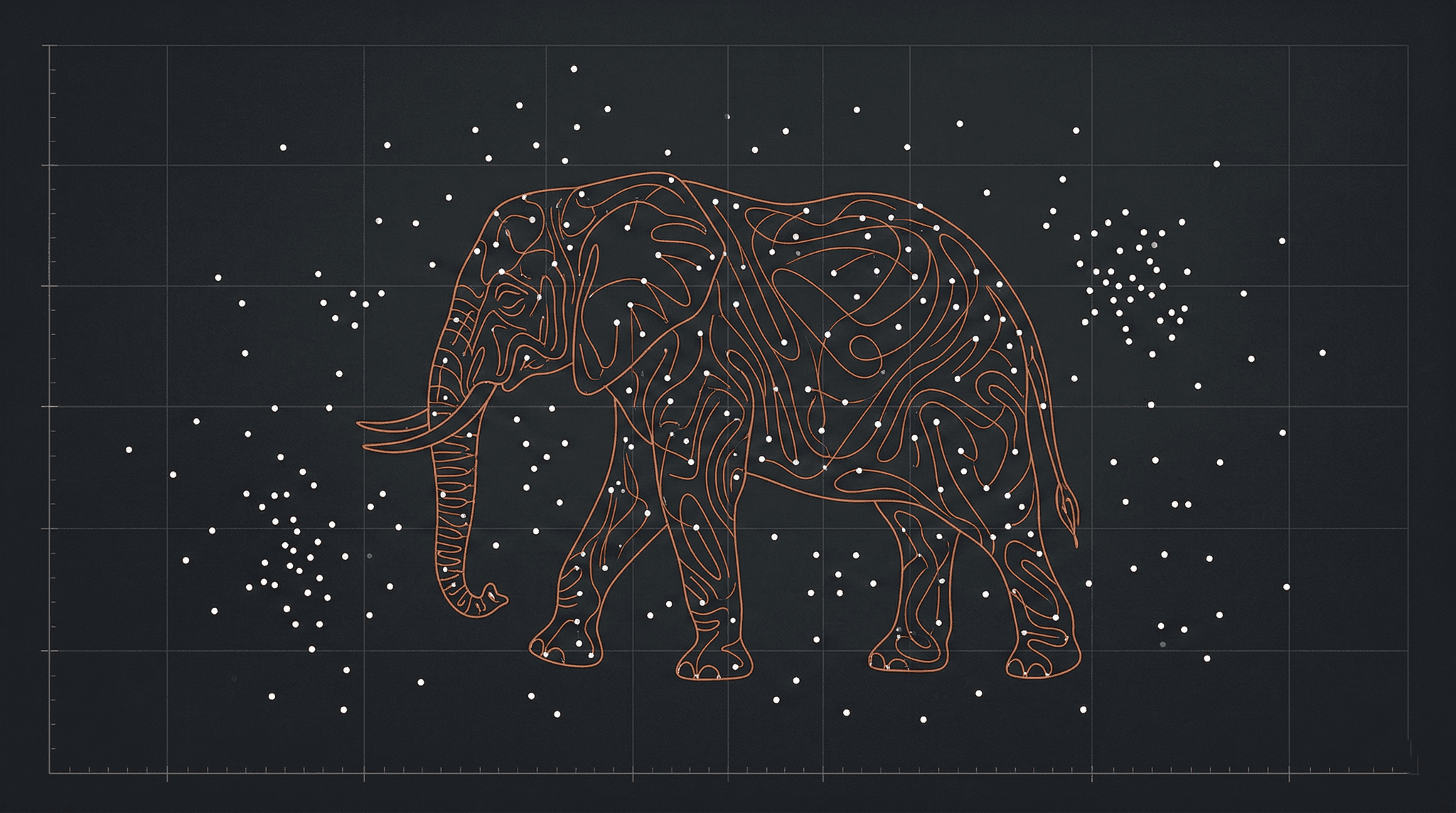
"With four parameters I can fit an elephant, and with five I can make him wiggle his trunk."
John von Neumann said that about curve fitting in general. In quant trading on 1-minute data, you've got 20 parameters and a very cooperative elephant.
What the Research Actually Says
Quantopian studied 888 live strategies. The finding: Sharpe ratios from 1-minute backtests had near-zero predictive power for live performance. The more a strategy was optimised, the worse it performed. Bailey & López de Prado demonstrated mathematically that after enough trials on the same dataset, finding a "profitable" strategy by pure chance is essentially guaranteed.
The academic consensus on sampling frequency is also telling. Researchers working on volatility estimation found that as bar frequency increases beyond a certain point, microstructure noise begins to dominate the true price signal. The optimal sampling frequency for most equity strategies is between 5 and 30 minutes — not 1 minute.
- Captures bid-ask bounce as signal
- 5M+ data points invite overfitting
- Ignores realistic slippage
- No intra-bar execution modelling
- Strategy breaks on regime shift
- Tests real execution prices
- Accurate slippage + brokerage
- Intra-bar price path modelling
- Walk-forward validation built-in
- Monte Carlo stress-tested
The Execution Reality Check
Even if your signal were valid, 1-minute backtests almost never model execution honestly. Your backtest assumes you bought at the 1-minute close. In reality, your market order moved the price, you waited for order routing latency, and you filled ₹0.35 above the close. Do this 200 times a month and the "alpha" you thought you had is entirely eaten by execution costs.
Practical rule: If your strategy doesn't survive adding 0.05% per trade in slippage + brokerage, it has no live edge. Most 1-minute strategies die right here.
Walk-forward optimisation is the standard fix for curve-fitting — optimise on a 2-year window, test on the next 6 months, roll forward, repeat. Most retail traders never do this because their backtesting tool doesn't support it. They run one optimisation on 5 years of data and call it validated.
What You Should Actually Do
Test on tick-level data, not OHLC bars. Use at minimum 8–10 years of data to capture multiple market regimes — bull, bear, crash, sideways. Model slippage realistically based on your typical order size vs. average traded volume. Run Monte Carlo simulation to stress-test the strategy across synthetic price paths, not just the one historical path you happened to test on. And always hold out a completely unseen out-of-sample period that you never touch during development.
These aren't nice-to-haves. They're the difference between a strategy that works and one that only worked on paper.
Test Your Strategy on Tick-Level Data — Free
TradeMade's backtesting engine runs on 10+ years of tick data with realistic slippage, brokerage, options Greeks, walk-forward optimisation, and Monte Carlo simulation. Drop your number — we'll set you up.
No spam. No cold calls. Just access.
The traders who consistently survive aren't necessarily smarter. They've just stopped trusting pretty equity curves and started demanding statistical rigour from their tools. That starts with throwing out 1-minute backtests entirely.